Menu

The National Portrait Gallery acknowledges the Traditional Custodians of Country throughout Australia and recognises the continuing connection to lands, waters and communities. We pay our respect to Aboriginal and Torres Strait Islander cultures and to Elders both past and present.

Aboriginal and Torres Strait Islander viewers are warned that this website contains images of deceased persons.

The Matildas Effect

by Sarah Oakes, 2 December 2025

The Matildas
The Matildas, 2025 Angela Tiatia. © National Portrait Gallery of Australia

On 20 July 2023 two culture-shifting moments occurred in unison. Greta Gerwig’s feminist masterpiece Barbie was released in cinemas across the country and in Sydney, the 2023 CommBank Matildas took their first touch of the ball in the opening match of the FIFA Women’s World Cup.

The Barbie movie presented a world where traditional male dominance had been erased and women’s experiences and achievements were centred and elevated. In the same moment, the Women’s World Cup gave Australians a real-life experience of this fictional premise as the media and the country fixed their undivided attention on a group of 23 female athletes.

In commissioning a portrait of the CommBank Matildas FIFA Women’s World Cup 2023™ Squad, the National Portrait Gallery needed to create not just a portrait of a team, but a moment in time. A moment that turned women’s soccer into a sold-out-stadium sport that overshadowed leagues, teams and tropes that had dominated our TV screens and sports fields for decades.
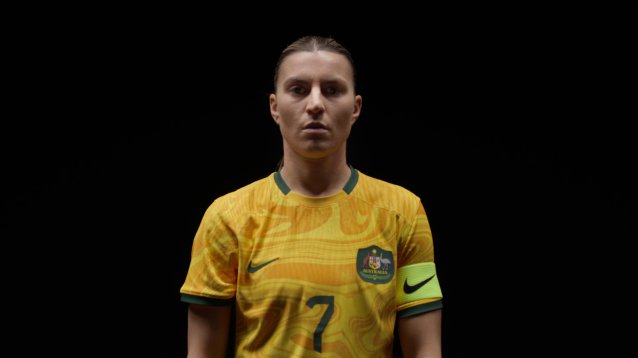
Still from Angela Tiatia The Matildas 2025

No stranger to delivering ambitious, large-scale projects, Sāmoan/Australian contemporary artist Angela Tiatia was invited by the Gallery to create the portrait. Tiatia works predominantly in video and in 2022 received Australia’s most prestigious prize for moving image art, the Ian Potter Moving Image Commission. That work, The Dark Current, debuted at ACMI (the Australian Centre for the Moving Image) in 2023 and has since won the Fisher’s Ghost Award and toured nationally and internationally. In 2017 she was commissioned by the Australian War Memorial and the National Museum of Singapore to make The Fall, a video work responding to survivors’ memories of the Battle of Singapore.

Reflecting on Tiatia’s selection as the artist for the commission, National Portrait Gallery Director Bree Pickering says, ‘What is so incredible about Angela’s works is that she looks at representation, but she understands and can depict beauty and strength in the most magnificent way. She sees women and she turns the gaze of the audience around.’

Still from Angela Tiatia The Matildas 2025

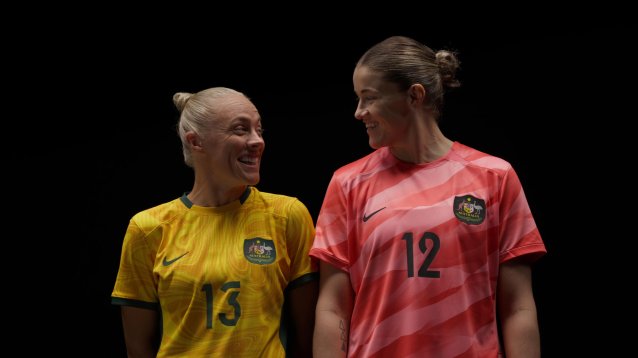
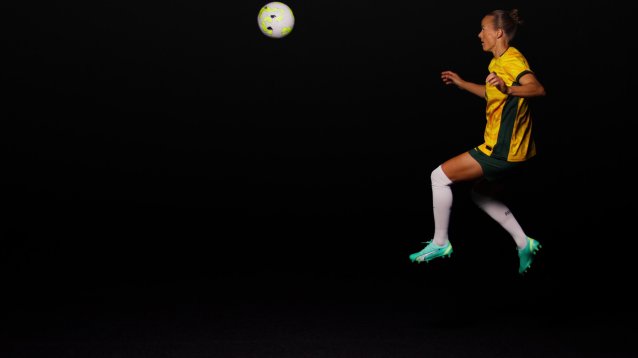
For Tiatia, being invited to create a portrait of a sports team was a thematic shift and one that presented a multitude of logistical challenges. Post World Cup the CommBank Matildas quickly dispersed around the globe to their respective club teams, meaning players now based across the UK, the US and Sweden would need to be captured remotely. Tiatia was determined to film the players in groups, as she attempted to illustrate the collective unity it takes to not only win a soccer match but to inspire the confidence of a nation.

Tiatia spent a year travelling, filming and editing the work. It took her to Texas for a CommBank Matildas match where she transformed a hotel ballroom into a studio, and to London for a single hour, slotted in after training, to shoot Matildas captain Sam Kerr.

Still from Angela Tiatia The Matildas 2025

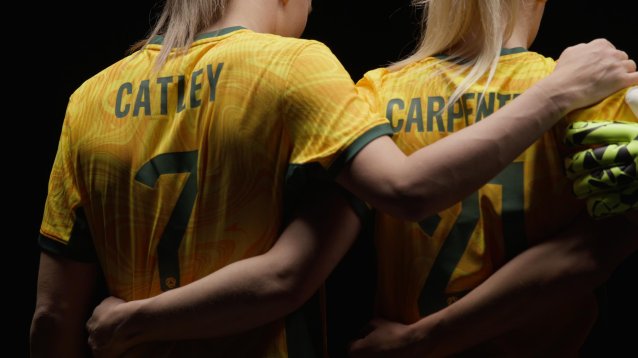
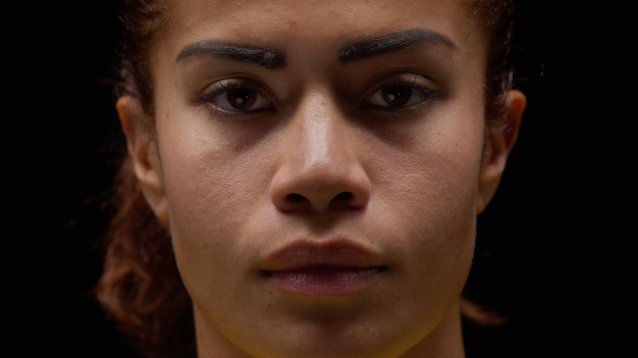
Tiatia’s approach involved filming the players in candid moments, guiding them through their pre-game rituals, and encouraging them to mentally shift into the singular, focused mindset they adopt before a match. Her method helped to recreate moments that had defined the 2023 World Cup for fans: Hayley Raso securing the yellow ribbon in her hair; Steph Catley and Sam Kerr strapping on the captain’s armband; and the steely gaze of goalkeeper Mackenzie Arnold, preparing to protect the net.

Despite the complexities and scale of the project Tiatia says that producing the work was a huge honour. ‘I have endeavored to capture their strength and power, not only as athletes; but also as icons.’ This is echoed by Pickering, who describes the impact and importance of the portrait. ‘Art should reflect our history and represent the present but it should also tell stories to the future, so that in 50 years’ time someone coming into the Portrait Gallery will be able to tell what mattered to Australians 100 years ago, 10 years ago, a year ago, today. The Matildas story matters, and is a critical one to tell.’

Still from Angela Tiatia The Matildas 2025

It’s rare to be able to pinpoint an exact moment of cultural impact, but the penalty shoot out in Australia’s quarter-final match against France is an exception. It was 15 minutes of excruciating tension, the longest penalty shootout in World Cup history (men’s or women’s). A moment when the nation collectively held its breath and, from the smallest of margins, watched their team prevail, victorious.

Australia woke up the next morning a changed nation, a place where women’s sports, at least in one male-dominated field, were now more visible than men’s. A country where the most viewed moment in Australian television history (11.15 million tuned in for the Matildas’ semi-final game against England) was now a team of elite female athletes dominating on the soccer pitch. A country where a women’s sports match could delay the start of an AFL game, and sell out our largest stadiums in a matter of minutes.

Still from Angela Tiatia The Matildas 2025

Tiatia leans into this moment in the creation of the work, inviting members of the squad to rewatch the agony and the ecstasy of the penalty shootout while being filmed. Matildas captain Steph Catley watched her teammate, goalkeeper Mackenzie Arnold, clear the ball from the goal line and goosebumps prickled over her arms. There was awkward laughter and unsuppressible smiles from the squad as the footage continued. Vice-captain Ellie Carpenter’s face contorted in a mix of pain and relief. Some players asked not to watch; more than a year after the game took place, it still feels too raw.

This intensity is the beauty of the work for Isobel Parker Philip, the Gallery’s Director of Curatorial and Collection. ‘It’s a portrait that contends with the monumentality of all that the Matildas represent but also creates space for us to see each player as an individual – there is emotional nuance in every frame, as we catch stolen glances and candid moments but also greet the steely gaze of the game-ready elite athlete.’

Still from Angela Tiatia The Matildas 2025

At the end of August 2023, the World Cup was over and the CommBank Matildas who, a month earlier, had been virtually unknown were now household names, heroes to a generation of Australians and at the helm of one of the country’s most bankable and exciting brands. Simultaneously the Barbie movie, finishing its extended run in cinemas, had smashed attendance records and become the highest-grossing film ever directed by a woman. It was, it must be said, a month to remember.

The CommBank Matildas did not win the World Cup, bowing out against England in a brutal semi-final, despite one of the most memorable goals of the tournament from Sam Kerr. However, the impact of their representation and the change it created, now known as The Matildas Effect, will be felt for generations. Those players, that moment in history and that cultural shift are now encapsulated and imbued in the National Portrait Gallery’s portrait by Angela Tiatia. 

All images: Still from Angela Tiatia The Matildas 2025. Commissioned with funds provided by Tim Fairfax AC and the Commonwealth Bank of Australia.

© National Portrait Gallery 2026
King Edward Terrace, Parkes
Canberra, ACT 2600, Australia

Phone +61 2 6102 7000
ABN: 54 74 277 1196

The National Portrait Gallery acknowledges the Traditional Custodians of Country throughout Australia and recognises the continuing connection to lands, waters and communities. We pay our respect to Aboriginal and Torres Strait Islander cultures and to Elders past and present. We respectfully advise that this site includes works by, images of, names of, voices of and references to deceased people.

This website comprises and contains copyrighted materials and works. Copyright in all materials and/or works comprising or contained within this website remains with the National Portrait Gallery and other copyright owners as specified.

The National Portrait Gallery respects the artistic and intellectual property rights of others. The use of images of works of art reproduced on this website and all other content may be restricted under the Australian Copyright Act 1968 (Cth). Requests for a reproduction of a work of art or other content can be made through a Reproduction request. For further information please contact NPG Copyright.

The National Portrait Gallery is an Australian Government Agency