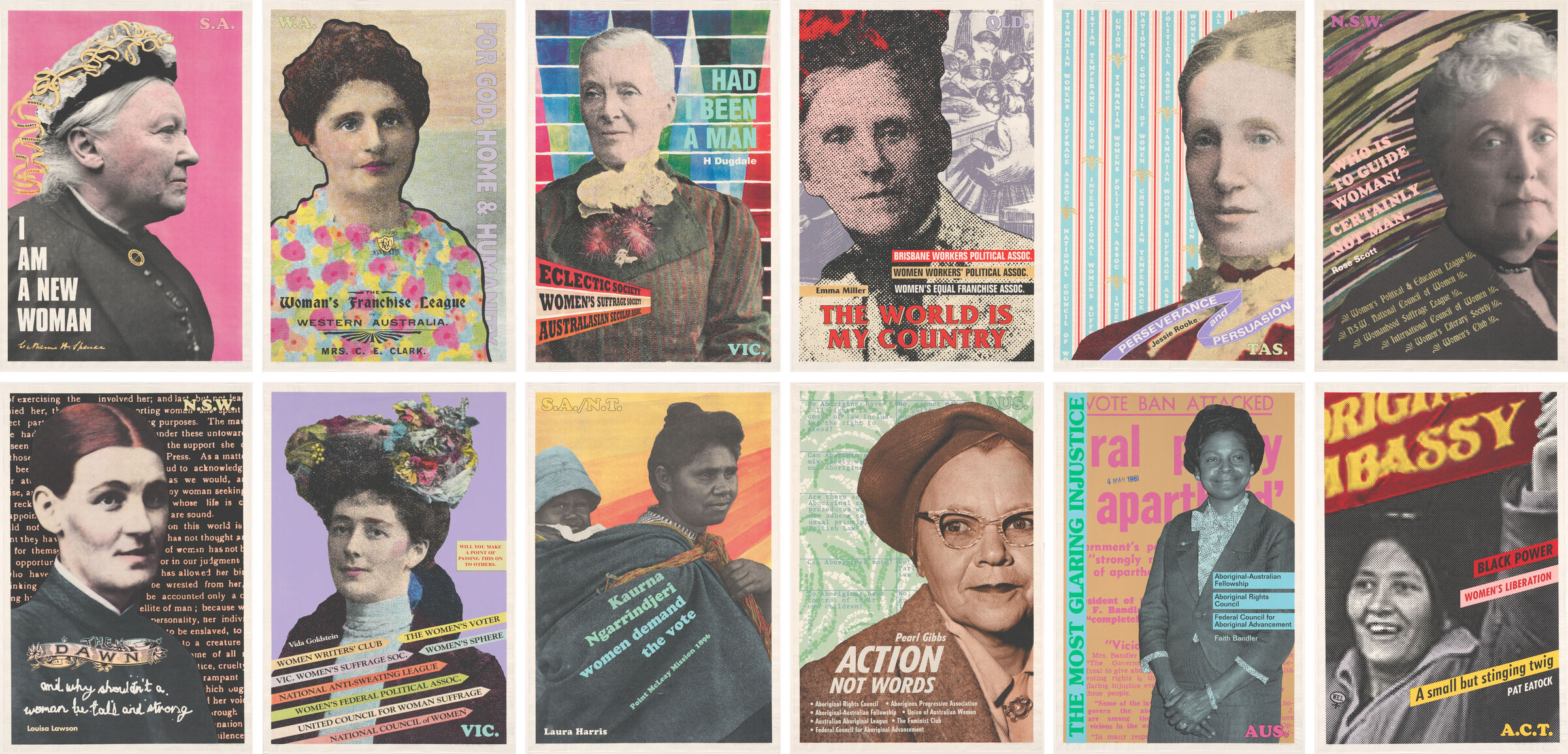
Celebratory but also blunt, Alison Alder’s I Am A New Woman (2024) is a collective portrait of 12 remarkable women who, through social, political and cultural activism, campaigned for a more inclusive democracy in Australia. By playfully adapting the visual language of political posters from the 19th and 20th century, Alder situates screenprints of historical photographs in a dynamic compositional space, with quotes, symbols and vibrant colour conjuring the immediacy and energy of social advocacy.
Produced during Alder’s time as the inaugural artist-in-residence at Australian Parliament House, and recently acquired by the National Portrait Gallery, this series of 12 screenprints builds on the artist’s prolific output of incisive social and political commentary through her printmaking practice. Each of the prints feature an individual activist; some have had their efforts broadly recognised in mainstream historical accounts, others remain lesser known. All have played an equally vital role in the struggle for representation, justice and equality in this country.
The title of the series is inspired by Catherine Spence, the South Australian writer and political activist who in 1905 famously said ‘I am a New Woman, and I know it’. In Alder’s representation of Spence, the black ribbon on her bonnet is replaced with yellow, referencing the yellow ribbon tied around the petition of 11,600 signatures demanding the right to vote which was presented to the South Australian parliament in 1894. Later that year, thanks to the advocacy of women like Spence, South Australia became the first Australian colony to grant women the right to vote.
Laura Harris, a Kaurna/Ngarrindjeri woman, was among the first to enrol to vote in 1895. Alder found the portrait of Harris in the collection of the South Australian Museum. ‘It has an unusual clarity for its time (c. 1908) with the added bonus of the viewer being confronted by the gaze of Harris’s child looking directly into the lens of the camera,’ Alder wrote in her artist’s notes for the series. ‘I decided to place her firmly in front of broad bands of warm sunlight, as Harris took her place in history, forging a path for the strong women who would follow her into the future.’
Like the portrait of Harris, the original source material used by Alder is the result of extensive research in museums, libraries and archives. The photograph of Faith Bandler, for example, taken when First Nations campaigners met with Prime Minister Harold Holt seeking support for the 1967 referendum, is from the National Archives of Australia. ‘I juxtaposed the cool and calm image of Bandler as a counterpoint to the strongly coloured words as she tirelessly lobbied the Australian people and their governments.’
Sometimes the source material found by Alder was limited to personal or social documentary photography, often of poor quality. The image of Henrietta Augusta Dugdale from the newspaper Woman’s Voice (1895) is one such example, but Alder was determined to include Dugdale in the series to honour her advocacy for gender equality. ‘I strengthened the image by positioning her in front of a geometric formation to signify her embrace of new ideas, with science and ethics as the framework of a new society. The bold pattern is emblazoned with her words “Had I been a man”, leaving the implications of what that may have been to the viewer.’
There was no such issue with her portrait of feminist and women’s rights activist Rose Scott, based on a 1913 photograph by May Moore in the National Portrait Gallery collection. ‘In this period of enormous social upheaval I imagined Scott maintaining a calm demeanour while forcefully agitating for a female revolution. I kept the colours strong and warm in the hand-painted background to signify the swirling forces of change and enable a clear focus on her face.’
By repurposing the familiar aesthetic of political posters, which share a tone with the kinds of placards still found at rallies now, Alder reminds us of how recently these battles over social and political equality were staged, and how they continue today. Seen through a contemporary lens, these collective portraits capture the energy of the trailblazers who were determined to change the world.
To learn more about Alison Alder’s I Am A New Woman series visit aph.gov.au