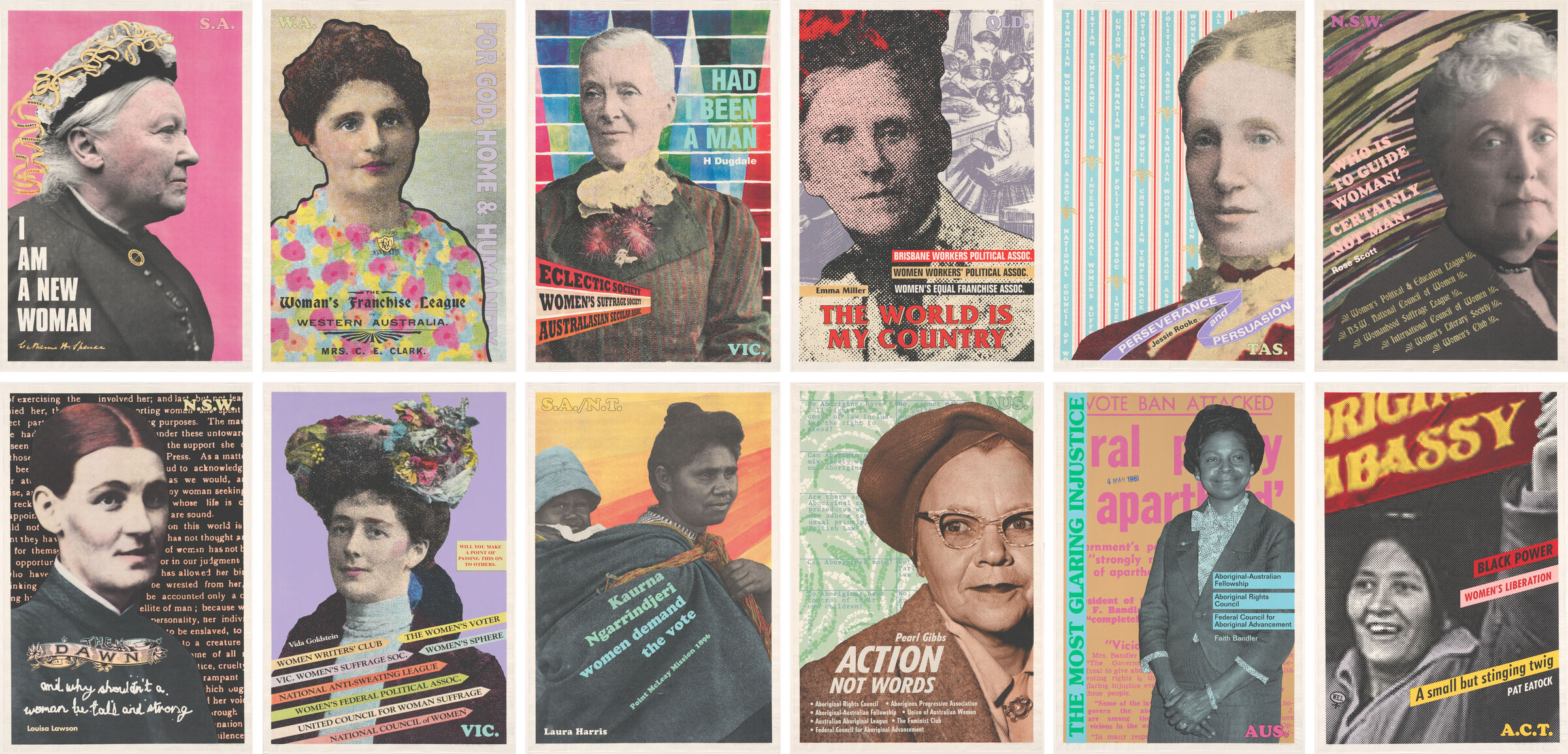
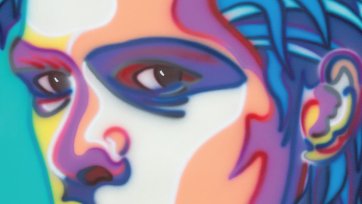
Catherine Helen Spence (1825-1910), writer and reformer, came to South Australia aged 14 and began her career with a number of pioneering novels, including Clara Morison (1854). From the 1870s onward, she urged various electoral reforms in SA's daily newspapers, particularly women's suffrage and the Hare system of proportional representation. An indefatigable campaigner for peace, charity, education and women's rights, she made a gruelling lecture tour of the US, Britain and Switzerland at the age of 67, returning to Australia to continue her campaigns for 'effective voting' and to stand as Australia's first female political candidate, in the Federal Convention elections in 1897. She never married, believing that women were made for more than 'making the world pleasant for men', but she raised three sets of orphaned children.
Rose Scott (1847-1925), feminist and social reformer, devoted much of her life to campaigns that resulted in increased independence for Australian women. Scott grew up near Singleton in New South Wales and with her sisters was educated at home by her mother, Sarah Anne. Scott became her mother’s primary carer in 1879; and the following year, on the death of her older sister, adopted her two-year-old nephew, Harry. In Sydney from 1880, Scott became increasingly involved in intellectual and political activities. She helped establish the Women’s Literary Society in 1889; and was one of the founding members of the Womanhood Suffrage League (1891) and the New South Wales National Council of Women (1896). A key player in the Australian campaign for universal suffrage, Scott was engaged in a variety of other social issues. Her report on conditions in Darlinghurst Gaol led to the opening of a separate women’s prison in 1908. She campaigned for legislation by which the age of consent was raised to sixteen (in 1910) and by which laws regarding child maintenance and the access of widows to their husbands’ estates were enacted. As was so for many feminists of the period, Scott’s beliefs were informed by conventional codes of femininity and morality. She fought moves, for example, to introduce state regulation of prostitutes and objected to the participation of women in professional sporting competitions due to the presence of male spectators. Scott was known for the salons conducted at her Woollahra home, where guests could expect to encounter Miles Franklin, Banjo Paterson, Vida Goldstein and others. She died in Sydney in 1925.
Vida Goldstein (1869-1949), activist, was the daughter of energetic social reformers. Having graduated from Presbyterian Ladies College, she became a teacher and conducted a preparatory school with her sisters in St Kilda between 1892 and 1898. Introduced into the fight for women's suffrage by her mother in 1890, she joined the Prahran Women's Franchise League and the National Anti Sweating League and in 1900, broadly recognised as the spokeperson for radical women in Victoria, was appointed general secretary of the United Council for Women's Suffrage. From 1900 to 1905 she owned and wrote the paper The Woman's Sphere. When the Victorian Legislative Assembly rejected the Women's Suffrage Bill for the seventh time in February 1903 (the year after Federal suffrage), she stood for a Federal Senate seat, becoming the first woman candidate and the first woman to register a vote at that booth under the Commonwealth Franchise Act. In spite of an extraordinary 51 497 votes, she was defeated. Brought to the London Great Suffragette demonstration by the militant Women's Social and Political Union, she was introduced as 'one of the foremost leaders of the Australian women's movement . . . now helping her sisters in England to win their freedom'. In 1909 she launched her second paper, the weekly Woman Voter. Goldstein stood for parliament again in 1910, 1913, 1914 and 1917, but she never gained a seat. Throughout the war she was an passionate pacifist, becoming chairman of the Peace Alliance and forming the Women's Peace Army with Adela Pankhurst, recently arrived from England, as an organiser. After the war she took an increasing interest in international matters, advocating disarmament and the pursuit of better living standards. Goldstein summarized her attitude to politics and public life as 'In essentials unity; in non-essentials liberty; in all things charity'.
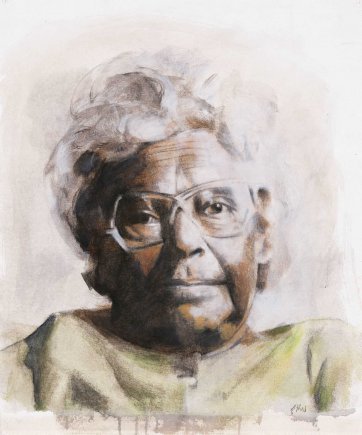
Faith Bandler AC (1920–2015), civil rights activist and writer, was born in Tumbulgum, New South Wales, to a Scottish-Indian mother and a cane-worker father from Ambrym Island, in what is now Vanuatu. While serving in the Australian Women's Land Army during the Second World War she observed the discrepancy in pay for Aboriginal people. Having married Hans Bandler, an Austrian Jewish refugee, in 1952 and settled on Sydney's North Shore, she began to work full time on Indigenous issues, co-founding the Australian-Aboriginal Fellowship in 1956. A year later Bandler was a founding member of the Federal Council for the Advancement of Aboriginals and Torres Strait Islanders, becoming NSW State Secretary and then General Secretary. Within FCAATSI she directed the ten-year campaign towards the constitutional referendum of 1967. It is widely acknowledged that her charisma and public speaking skills were fundamental to the outcome of the referendum, in which more than 90 per cent of voters endorsed the removal of provisions from the Constitution that discriminated on the basis of race. After leaving FCAATSI in 1973, she devoted her energy to her father's people and was central to the foundation of the Australian South Sea Islanders United Council. Bandler also wrote five books, including Wacvie (1977), a biographical novel about her father, who was taken from his home and enslaved on a sugar plantation in Queensland at the age of twelve. Awarded a Member of the Order of the British Empire for services to the community in 1976, she refused to accept it in protest against the dismissal of Gough Whitlam. Bandler gained an honorary doctorate in 1994 and received the Human Rights Medal in 1997.
Purchased with donor funds 2024
The National Portrait Gallery respects the artistic and intellectual property rights of others. Works of art from the collection are reproduced as per the
Australian Copyright Act 1968 (Cth). The use of images of works from the collection may be restricted under the Act. Requests for a reproduction of a work of art can be made through a
Reproduction request. For further information please contact
NPG Copyright.